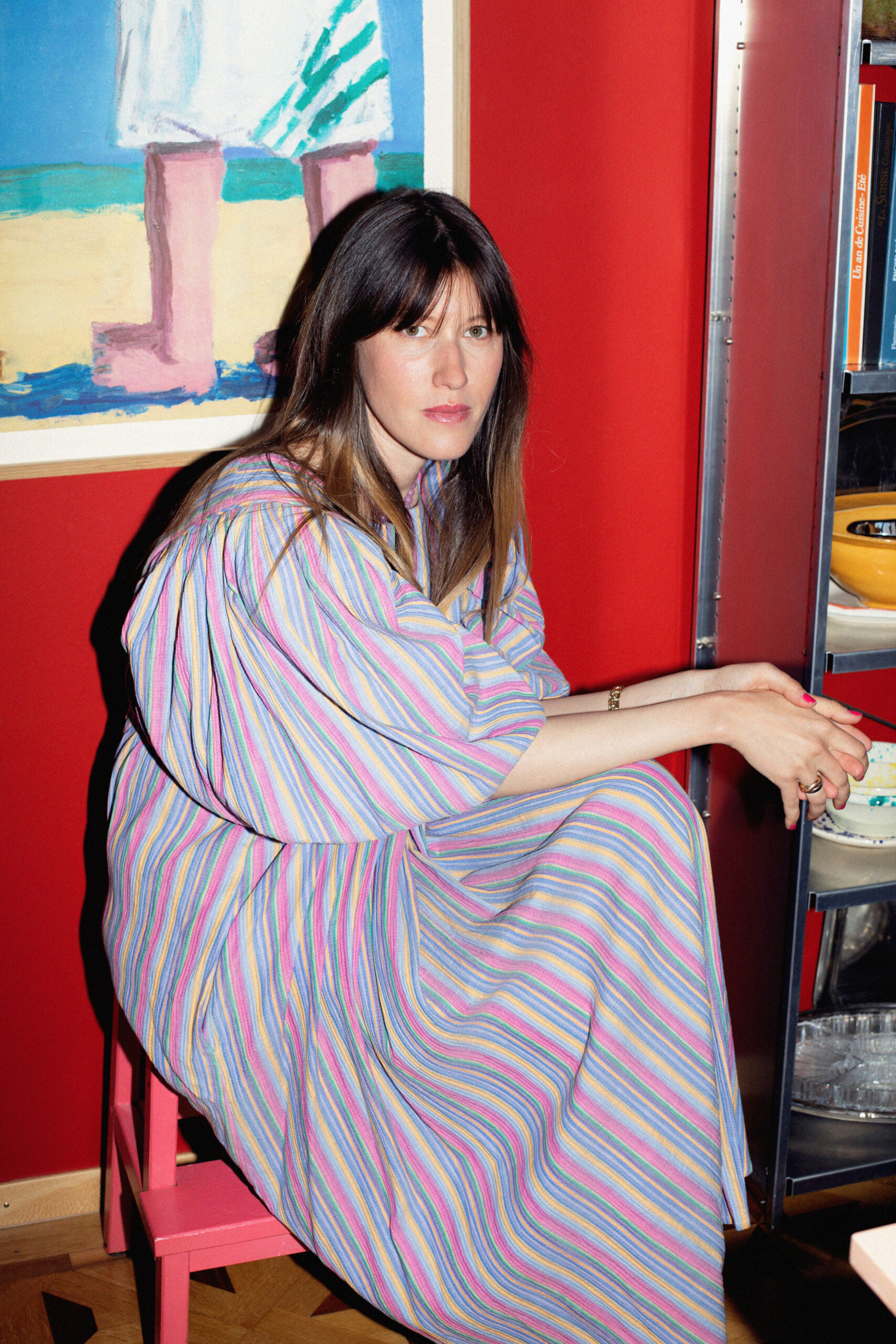
We meet the stylist and creative director in her atelier on Rue Cingria in Geneva. Here, in around twenty square metres, she works with jewellery designer Lyla Marsol on their shared brand Aglagla, which they founded eighteen months ago. Marsol is sitting in concentration at the window table, AirPods in, threading pea-sized pale-blue beads onto a necklace. From contemporary and vintage beads she creates necklaces, bracelets and earrings by hand – many in limited editions or as one-off pieces. Bowls of glass beads, stacks of old magazines and loose scraps of paper are everywhere. “It’s chaos,” says Mutsaerts almost apologetically, as her dachshund Albert weaves between her legs. She herself handles communications and translates each piece of jewellery into the visual world of the internet.
The duo have just returned from the Milan Furniture Fair – the next pop-up events are coming soon. Clients now order from the US, Asia and Scandinavia. “Things are going well, we’re in a growth phase,” Mutsaerts says. There’s pride in her voice – but also respect, because rising demand also brings the challenge of preserving the character of the brand.
Not long ago, an important chapter ended for Anouck Mutsaerts. For nine years, the 32-year-old worked as a freelance stylist for T, the lifestyle magazine of Le Temps. It was her first major job. There, she says, she learned a great deal, made important contacts and built up a wide network. “I was very closely tied to that work,” she says. At the same time, the wish to realise her own projects grew.
The search for her own form of expression began early. Anouck Mutsaerts was born in Singapore to Dutch parents. The family later lived in Switzerland, before Anouck, in her early twenties, moved alone to London to study journalism. “I’ve always loved narratives,” she says. Stories, characters, whole worlds. The academic side of journalism quickly disillusioned her. London, by contrast, changed a great deal. “The city is so alive. People dress with confidence and have a real sense of individuality. It opened up a whole new side of me.” As a child and teenager, she was rather shy and introverted. “I was always considered the strange girl.” In London, she had the feeling for the first time of not needing to explain herself. There she immersed herself in photography, became interested in archive fashion – collecting historically significant pieces from past designer collections – and understood that clothing could be more than mere surface. “Fashion helped me feel more at ease in my own skin.”
Back in Switzerland, she did a Master’s in art history, wore her hair short and white, and collected more and more clothing and objects. “I was obsessed,” she says, laughing. Her then-boyfriend eventually said to her: “You need to move to Paris and work in fashion.” So she packed her suitcase and went. In Paris, at first, she moved from one badly paid internship in commercial department stores to the next. “It was so boring,” she remembers. She wrote to stylists, spoke to different people and finally began working as an assistant to Elodie David, today Fashion Director at Harper’s Bazaar France.
“Styling was a way for me to connect my narratives with form and colour. My brain is like a collage,” Mutsaerts explains. For a shoot, she’ll place courgettes in striped egg cups from the Zurich lifestyle label enSoie, or hang a Chanel diamond necklace in the fridge. Her image worlds feel playful, never forced, often with subtle humour. Dark purple, though, she doesn’t care for.
With colours, Mutsaerts otherwise trusts her instinct. “I know there are all these systems – colour therapy, what shade suits which skin tone – but for me they don’t work.” Of course there are times when she tries to push her narrative too hard, she says – and then the work usually loses some of its expressive power.
Anouck Mutsaerts tries, on the whole, not to overthink everything: Is this healthy? Does this go together? She is a hedonist, she says, not particularly strict but attentive. During our conversation she drinks Sprite, draws on her e-cigarette and speaks without any of the attitude one tends to encounter in fashion people. At the same time, she describes herself as very sensitive. She picks up sounds, smells and moods with great intensity. During pregnancy that grew even stronger. For a while she could bear neither the scent of her husband nor that of her favourite candles. “Fortunately, that’s gone back to how it was.”
She met her husband Pol, a gallerist, on a plane on the way to the art fair in Monte Carlo. “We knew each other slightly through mutual friends but had never really spoken. And there we were, sitting next to each other. Something like that doesn’t actually happen! You don’t just end up sitting next to someone you find cute.” In September last year, their son Lars was born. About her pregnancy, Mutsaerts speaks strikingly unvarnished.
“Honestly, I didn’t feel well at all during the pregnancy.” She was constantly nauseous, didn’t find herself pretty. Stylistically, too, it wasn’t the best time of her life. “I think women tend to romanticise this phase, this whole image of pregnancy glow and a beautiful birth.” Becoming a mother is of course something extraordinarily precious. “But I think we sometimes expect too much for everything to be beautiful. Real life isn’t always aesthetic.”
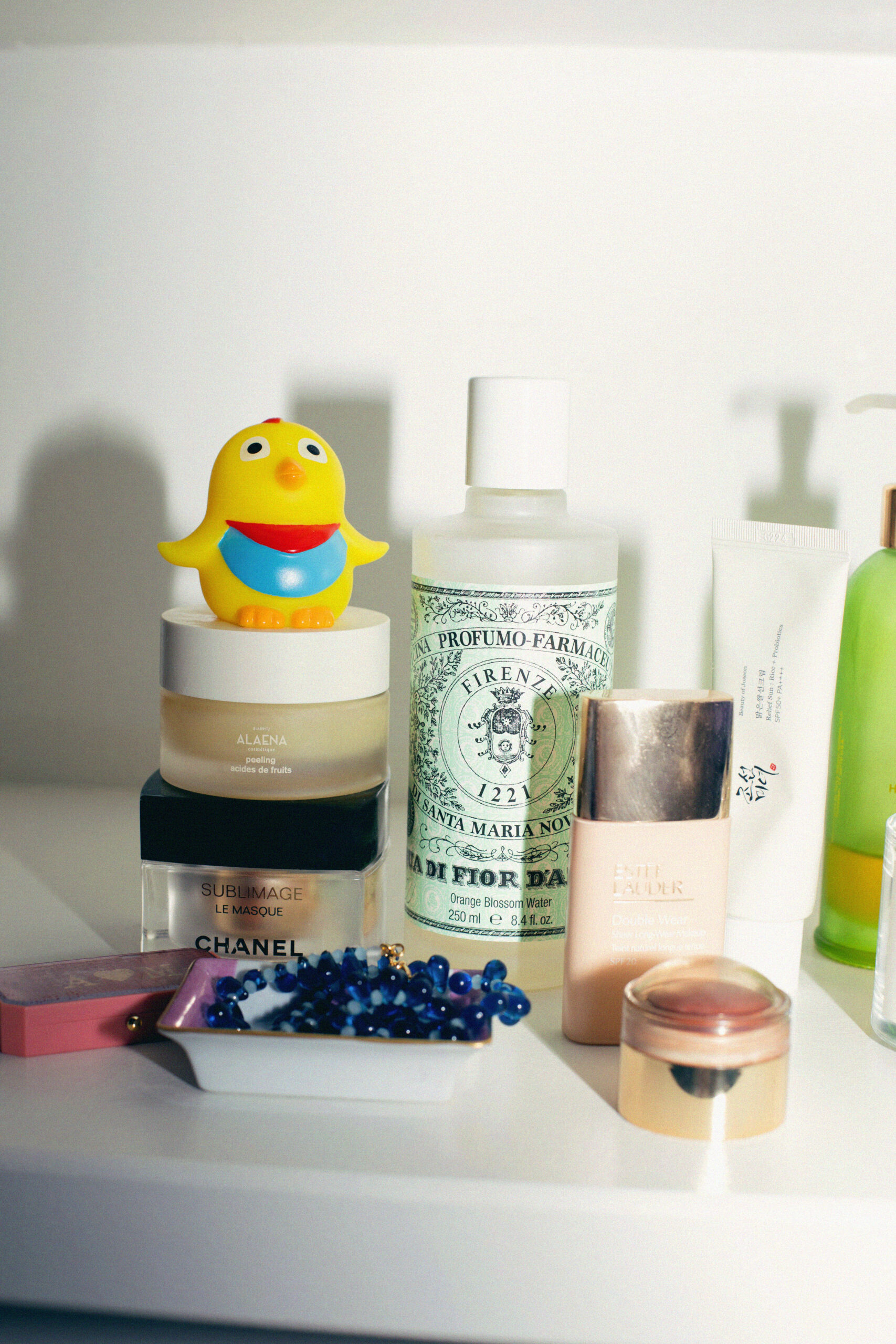
Her relationship to her own appearance has not fundamentally changed because of it – just her daily routine. “A quick wash of the face and a bit of blush,” she says pragmatically. All the more, she savours small self-care moments in between, like sauna visits. She likes running through Geneva at night with dachshund Albert, listening to techno, and she runs, swims or sails. Her husband Pol, who grew up in Brittany, is a good sailor.
Beauty, says Mutsaerts, has little to do with perfection for her. “Of course there’s physical beauty. But what really stays is personality and charisma.” She talks about energy, presence, curiosity, humour and warmth. About people who don’t pretend. Much of what makes up her own aesthetic, she finds in galleries, museums, old magazines or music. She listens to eighties garage as much as to romantic Italian pop by Eros Ramazzotti. “The children’s songs I now listen to with my son, though, are starting to get on my nerves,” she says drily.
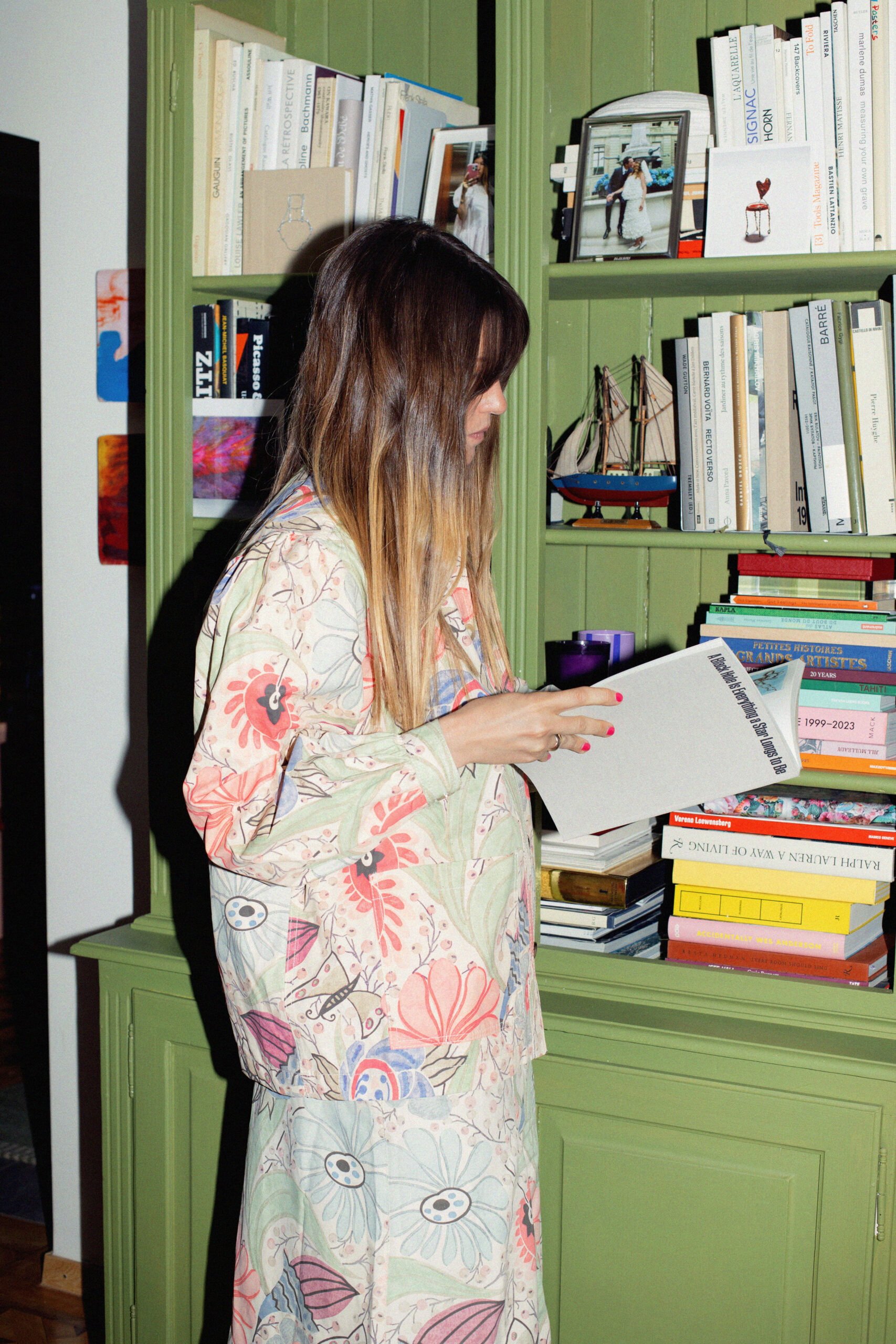
Privately, Mutsaerts surrounds herself with people who view culture and design in a similar way to her. Her husband Pol plays an important role in this. “He’s very cultivated and has an incredible number of references in his head,” she says. At the same time, she describes him as calm and patient – the opposite of herself. “I’m more the hyperactive type.” With him, she can be every version of herself and feel entirely accepted. When he first entered her colourful flat, he said: “Oh my God, this is intense!” Today, even in his wardrobe, there are a few colourful pieces.
Beauty, it becomes clear over the course of this afternoon, is for Anouck Mutsaerts often found in unforced moments. For her, that can simply be a city bike, freshly washed hair in the wind, and a dachshund tucked into the front basket.