Words: Elena Berchermeier
Photo: Parole Dure / deathtostock
Opinion
This summer put us through it. And it showed us something about the body: left to its own devices, it sets a pace we can trust.
What if we finally made peace with summer? Stopped treating it as a season that demands optimising, and let it be what it can also be: a warm embrace. The kind you linger in a little longer than you need to, feeling the body loosen.
Summer runs on a different clock. The temperatures alone, now routinely extreme, and the fact that we retreat into the shade whenever we can, shrink how much ground we cover. We need more pauses.
Of course, warmth is comfort. Warmth is exhaling, leaning back. It’s one of the best reasons to slow everything down. But it’s also a force we don’t always get to control, as the past few months have made clear.
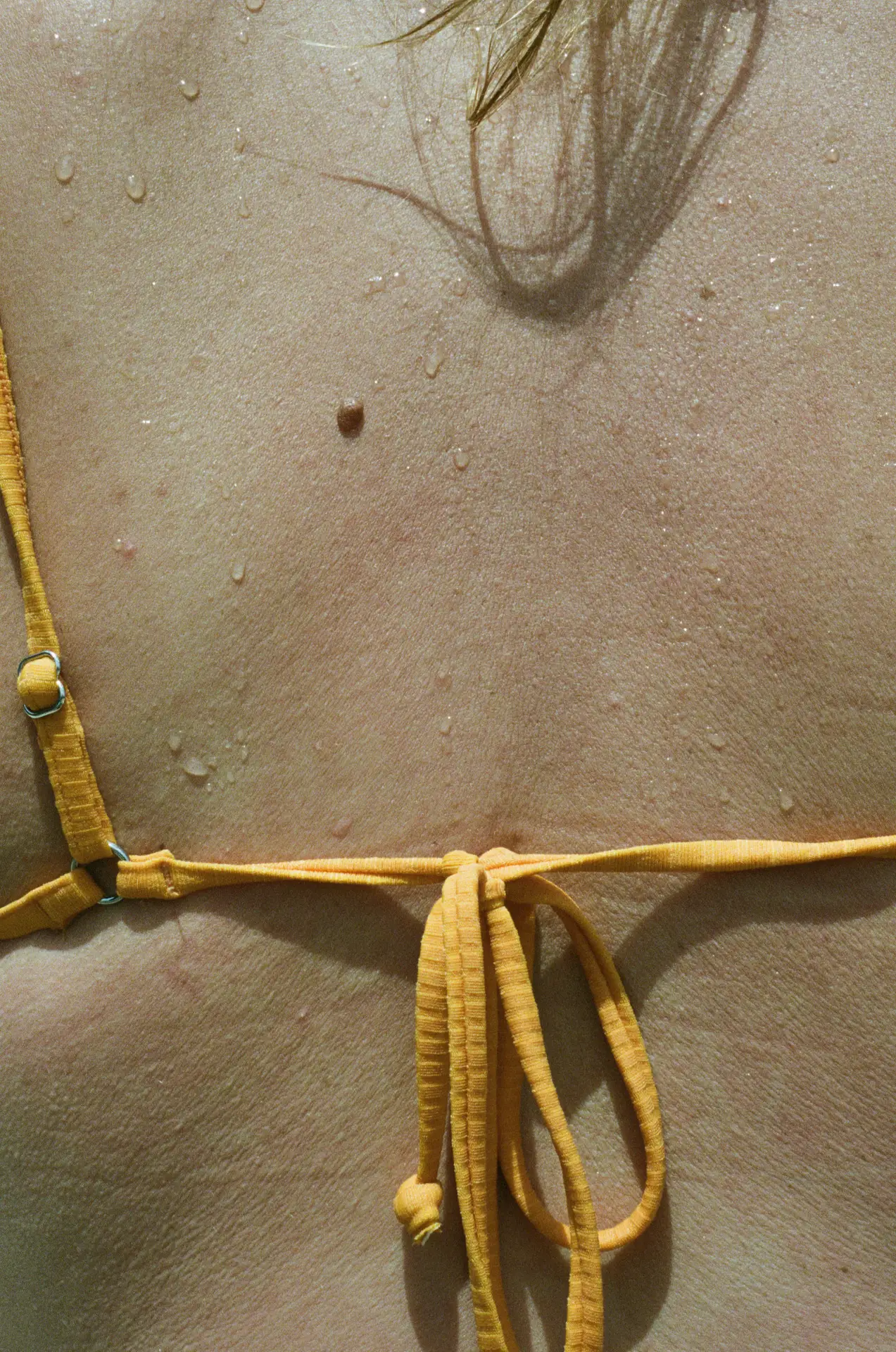
We feel it in the body, for one. It grows heavier. It refuses to be ignored: it sweats, sleeps worse, feels somehow heavier and softer at once. It just changes. Summer shifts how we feel. Our schedules, and what we expect ourselves to deliver, barely notice.
For all our devotion to longevity, to making the most of every single day, summer doesn’t have to be about optimising anything. If anything, this is when the body could use some support. Slowing down, doing less, has nothing to do with a lack of discipline. It’s just what happens. Maybe the answer is asking less of ourselves, and being kinder about it. A breath. A moment of attention to what the body does when it heats up. Which is more than you’d think.
THE BODY MAKES ITS OWN RULES
Kristie Ebi, an epidemiologist and professor at the University of Washington, has spent more than three decades studying how heat and health intersect. Her work makes one thing clear: when it gets hot, blood flow to the skin increases, which triggers sweating, all in the name of keeping our core temperature steady. The cardiovascular system works harder, while the body loses fluids and minerals. It’s a strain on the whole system. The result: we grow tired, slower to react, harder to focus, because the body’s attention is elsewhere.
Structurally, though, our daily lives barely register any of this. Meetings happen regardless of how hot or sleepless the night was. Deadlines don’t move, not even when a clear thought feels out of reach. Everything is expected to carry on exactly as before.
Exactly how much heat affects our ability to work is something the WHO and the WMO have put a number on, in a joint report from August 2025 titled Climate Change and Workplace Heat Stress. Past a heat stress threshold of 20 degrees, measured using what is called the Wet-Bulb Globe Temperature (a metric that accounts for humidity, wind and sun exposure alongside air temperature), productivity starts to measurably decline: by two to three percent, on average, for every additional degree. Work remains possible. But performance drops noticeably with each degree beyond that point.
Maybe the mind needs more pauses too. It runs a little slower in the heat as well. Our thoughts drift, these days, towards good ice cream and shady corners worth lingering in. Something has shifted here too, over the past few years: we protect ourselves, we retreat. Instead of chasing full sun, we take the warmth under a tree, where the view of the sky is better anyway, where you can listen to the branches move and watch the leaves shift.
At the same time, surrendering to summer like this is a real privilege. Not everyone gets to avoid the midday heat, lighten their workload, or adjust their rhythm to the season. People working in care, hospitality, agriculture, logistics or construction can’t simply decide to spend the rest of the afternoon somewhere shady.
Which is exactly why this matters: rest can’t be a luxury. Time off shouldn’t have to be earned.
Esther Lynch, general secretary of the European Trade Union Confederation, insists that the world of work can adapt to heat. Heatwaves, she argues, are predictable, and their worst effects can be softened through proper planning. She is calling for clear, job-specific temperature limits and binding strategies for extreme weather. “Heat is now a predictable workplace risk,” she told Euronews Health in June 2026.
WHEN THE BODY SPEAKS FOR ITSELF
It isn’t only our work culture that expects the body to function regardless of temperature. Language has shifted too. A Summer Body is no longer something to chase. It can simply be a name for whatever our body looks like in summer, met with a bit of goodwill. We know sleep matters, and that it works differently in summer than it does the rest of the year.
Skin, too, has its own response to heat, says cosmetic scientist Dr Meike Streker: in summer it thickens, and the tan that develops along the way is part of that same defence.
It sounds caring. Often, though, it’s just biohacking in disguise. Even rest has to be perfect now. Electrolytes are trending because they balance our fluids, sleep tech tracks how we rest, and we test recovery routines for maximum efficiency. Where, in all this, does simple, sweet doing-nothing fit in, the kind that’s sometimes the most restorative thing there is? Does rest even work, if we plan it down to the minute instead of just enjoying it?
We don’t need to brace ourselves for summer at all. The body takes care of that on its own. It decides, entirely by itself, how it wants to be: a little slower, a little less driven. Some days it’s tired and glistening with sweat. Other days it’s puffy and just feels different. We can watch. We don’t have to judge. Or, put differently: in summer, our ambitions around longevity and self-optimisation are allowed to simply dissolve.
Of course, self-acceptance isn’t an all-or-nothing thing. Sometimes it looks like simply not ignoring the body, and scaling back what we expect of it. Seeing ourselves differently, realising that less is sometimes enough. Less make-up. Less styling. Less of everything trying to shape us. Clothing can be something that brushes lightly against the skin instead of something that constrains it.
WHAT SUMMER LEAVES BEHIND
And what happens once the days turn cooler again? We pause for a moment. What do we want to take with us from summer? Which feeling gets to stay?
Maybe it’s the realisation that we don’t have to speed back up automatically. The body has its own rhythm. And we can meet it with the same warmth summer once wrapped around us.